Showing posts with label race. Show all posts

On Black Women, Teen TV, and Fantasy Space

When I hit puberty, I was Jezebel. The world made it pretty clear that any black girl with big breasts must be up for anything. In high school, as I got older and fatter, I became Mammy, ready to lend a maternal ear to anyone. Then I went to college, started studying the media, and became Sapphire, perpetually angry about something. None of these things were me, but I realized that people wanted to be able to more easily categorize my existence, and they were just using the tools they had. I grew up going to predominantly white schools, watched mostly mainstream white TV, and lived in a white world. Outside of my home and church, everything I was exposed to was reductive when it came to race. And as a kid (and adult) who loved television, I became inured to the fact that I was rarely going to see anything that challenged those stereotypes.

This all changed when my brother had kids, and I realized that one of the things I wanted for them was to have no expectation that the stories they consumed would portray them as an amusing accessory for the main characters. My nieces are now twelve years old, and their environment is a lot like mine was. They never say it directly, but it’s becoming increasingly clear that they want to listen to what their friends listen to, and watch what their friends watch, and still find a way to see themselves in what they’re consuming.

One of their favorite TV shows is Glee.  We have this thing where whenever we watch it, and the characters Sam and Mercedes (who are white and black, respectively) interact, I tend to say, "You know why [x happened]? Because they're in love."  We're big dorks, so they put up with me doing it.  But they're constantly talking about how it's their favorite couple on Glee, and they're more emotionally invested in it than I’ve seen them be about anything else on TV.

Here's the thing: the black girl on an average U.S. TV show rarely gets a romantic storyline. She's the best friend, and she hangs out in the background making snarky comments, and occasionally they introduce a prop boyfriend who exists to round out the couples.  So the fact that this one show, one that all my nieces’ friends watch, is making this an actual plotline is amazing.  There's a black girl in a love triangle involving two boys who think she's special and talented and worth fighting for, and that tells the audience that she is.

I know how dangerous it is to place your expectations of validation on media products, especially validation through heteronormative romantic success, which is a problematic concept in and of itself. But it’s still the primary way the media tells us that women characters are worthwhile.  I’m extremely ambivalent about this because, problematic or not, I believe that everyone deserves fantasies, and it’s a fantasy that black women are generally denied access to.  

I've noticed that in the past few years I've found myself having to explain to my girls why they never even see anyone on TV with curly hair.  They're aware that the media is telling them that they're not worthwhile and that they don't deserve fantasies starring people who look like them.  So this one storyline has been hugely important to them.  The magic box that sells them stories is actually saying, "Look, there's a big black girl and she doesn't have to look or be just like everyone else to get the same things everyone else has.  She's perfectly fine just the way she is."  And that's good for them.  Hell, that's good for me.

I want my girls to grow up watching a media landscape where people who look like them are considered both important and normal.  I want them to feel like the world actually sees and values them.  I want them to know that their stories are stories worth telling.  And being able to watch this one little storyline on a show they like is helping to communicate that to them.


My interests are mainly in the stories mainstream media sells and how we negotiate their portrayal versus our reality, but it’s extremely important to note that there are options out there that provide different voices.

The Queer Women of Color Media Arts Project is a San Francisco-based group that not only holds film festivals showcasing the work of queer women of color, but provides training to teach them how to tell their own stories.

Voices from the Gaps is a teaching resource from the University of Minnesota that provides essays and reviews of work done by women writers and artists of color. There are interviews with people like Sandra Cisneros and Zadie Smith, and a treasure trove of book reviews.

And, finally, one of my favorite blogs is The Crunk Feminist Collective, a group of writers who come out of the hip hop feminism movement and have insightful critiques on media and current events.
I'm all about the hypocrisy.

So, I was looking at my well-worn copy of The Annotated Pride and Prejudice and thinking about how much I love Regency stories and how problematic that is. Basically, I grew up on Austen and romance novels, in which no one ever talks about where the money is coming from. No one ever says, "and then I slaughtered a hundred people in India so I could come home to you, my darling."

The hypocrisy of my position was really brought home to me when my sister-in-law told me that her favorite movie is Gone With the Wind. My initial reaction was, "Really? You live in a house full of black people, how does that work for you?" But then I thought about how I couldn't exactly be bothered by her love of a romanticized story of a society built on torture and oppression when one of my favorite hobbies is reading romanticized stories of a society built on torture and oppression. So I bought her the movie for Christmas and then went back to reading Julia Quinn and Jo Beverley.

Moving in the World as an Immortal White Guy

Throughout this semester, I kept meaning to make blog posts about my random media observations, so there will be an influx of seemingly random 500(or so)-word dissections of the stuff that has crossed my mind that I haven’t gotten around to talking about. Mostly TV, because that’s how I roll. First up, Doctor Who.

I have this obsession with immortal/long-lived characters, probably from a childhood spent bingeing on comic books and fantasy novels. I never had a time-travel fantasy as a kid, because I had an inkling that “black” and “woman” were not going to serve me well in most of the places that the characters I liked traveled to, but I still loved the concept. So Doctor Who and Highlander were go-to media products for me as a kid and teenager, and the New Doctor Who has been one of my favorite shows. Here’s the thing I find interesting in watching Doctor Who now that I didn’t as a kid: extended age, with all its attendant implications of wisdom and experience, is a white male domain. Yes, I get it, when you’re casting a UK/US show, your protagonist is a white guy. I’m not talking about the reasons for why this happens, I’m talking about the values it imparts to the show and how those casting strictures end up constructing a certain reading of those qualities.


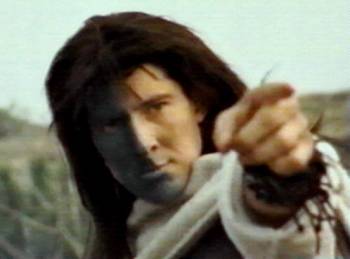
On Highlander (the TV show), there was a character named Methos who was 5000 years old. He was a recurring character, and most of the storylines involving him used him to make a point about we poor benighted mortals and how we spent too much time on the wrong things, and how he’d lived, you see, so he could understand that our petty differences were insignificant. The casting was apparently race-blind, and they just happened to find a white guy who was the best for the part (in British Columbia. I know you’re shocked). The interesting thing here in terms of how whiteness is constructed is that it is an unmarked category. The character is placed in all kinds of situations across 5 millennia and he is always accepted without question, and rarely with a discussion of, “hey, what’s that white dude doing here?”

This works to normalize the idea of default whiteness, where of course a white man can enter any situation and not have to worry about his cultural position relative to his surroundings. The characters who occupy a different cultural position are guest stars, not POV characters, and they are not meant to be part of the fantasy role-playing for the audience. The show places the audience at the same level as the main characters (all but one of whom are white men, the last is a white woman), and says, “you could be here! If you found yourself in 9th century China as a white guy, everyone would think you were just one of the gang!” Highlander serves as just one more example of how one of the insidious parts of default whiteness in casting is that it frequently makes no sense and blinds the audience to the fact that the people who are not white are also protagonists in their own story that the current text is just not telling.

Doctor Who, which prompted this rant, is a slightly different case because there has been discussion about casting the character with a non-white actor. Oddsmakers were laying bets on Paterson Joseph before the last casting decision (and he would’ve been awesome.)


My problem with Doctor Who is not so much the default whiteness, because, at least in the new series, people talk about race! The black girl says, “oh hey, is it safe for me to be here?” like I expect I would say when transported to the past in Europe. Where the issue for me comes in is the buildup of a national mythological figure, who is presented as nearly omniscient, and is always embodied in a white male figure. And embodied in increasingly young white male figures as time goes on. It isn’t a problem with the actors. In fact, the most recent incarnation is a 26-year-old, and I find him more believable as a character his age (over 900) than previous actors. The issue is that it’s taken for granted that these characters will be believable, and the argument against a woman or a person of color among fans is frequently that they would not believe the character were it not a white man. It’s never stated directly that there’s an assumption of authority in that particular body, but it’s underlying in the outrage against other options (alongside the racism and misogyny.)

What I wonder is where I stand in terms of accepting the characters that don’t fit this paradigm. When reading about characters who aren’t white men who live long lives or are immortal, I have little problem accepting the character. But when watching these characters, I find myself thinking, “Is anyone going to treat them unfairly? Will someone call attention to their race/sex? Is it safe to be that person is that position?” The process of seeing the character makes them more embodied for me, and cuts off options for imagination. And reveals that the extent to which I’ve accepted the concept of whiteness and maleness enabling one to move in the world freely is really disturbing.